
Still comparing sizes? Compare current BLUETTI power stations by capacity and use case →
Camping power · Sizing guide
Choose a camping power station from your daily energy use—not from a wattage label alone.
For camping, the key number is watt-hours per day (Wh/day). Add the energy used by your fridge, lights, laptop, phones, camera gear, CPAP or other devices, then add reserve for conversion losses and unexpected use.
Quick answer: Around 300–500Wh can cover light electronics. Around 1kWh is a practical class for car camping with laptops, lights and selected refrigeration loads. Around 2kWh gives more margin for multi-day use, heavier appliances or several people. Your actual loads decide the size.
How to calculate the power station size you need
Use this basic formula for each device:
Energy (Wh) = Watts × Hours used
Then add all devices together. If a device cycles on and off—such as a refrigerator—use measured average energy over a representative period when possible instead of multiplying its nameplate watts by 24 hours.
1. List every load
Phones, lights, fridge, laptop, camera batteries, fan, CPAP, coffee maker and anything else you expect to power.
2. Calculate daily Wh
Multiply watts by hours of use. For chargers, a plug-in energy meter gives a better answer than guessing from the adapter label.
3. Check inverter output
High-wattage appliances such as kettles, coffee makers and induction cooktops can require far more instantaneous power than phones or laptops.
Camping power-station size classes
| Battery class | Best fit | Main limitation |
|---|---|---|
| 300–500Wh | Phones, lights, cameras, tablets and light laptop use | Limited margin for refrigeration or multi-day trips |
| About 1kWh | Car camping, laptops, lighting, selected 12V fridge loads, CPAP and device charging | Heavy cooking loads can drain it quickly |
| About 2kWh | Multi-day base camp, RV support, remote work, larger refrigeration loads and multiple users | Much heavier to carry |
Best portable power station for camping: current BLUETTI options by use case
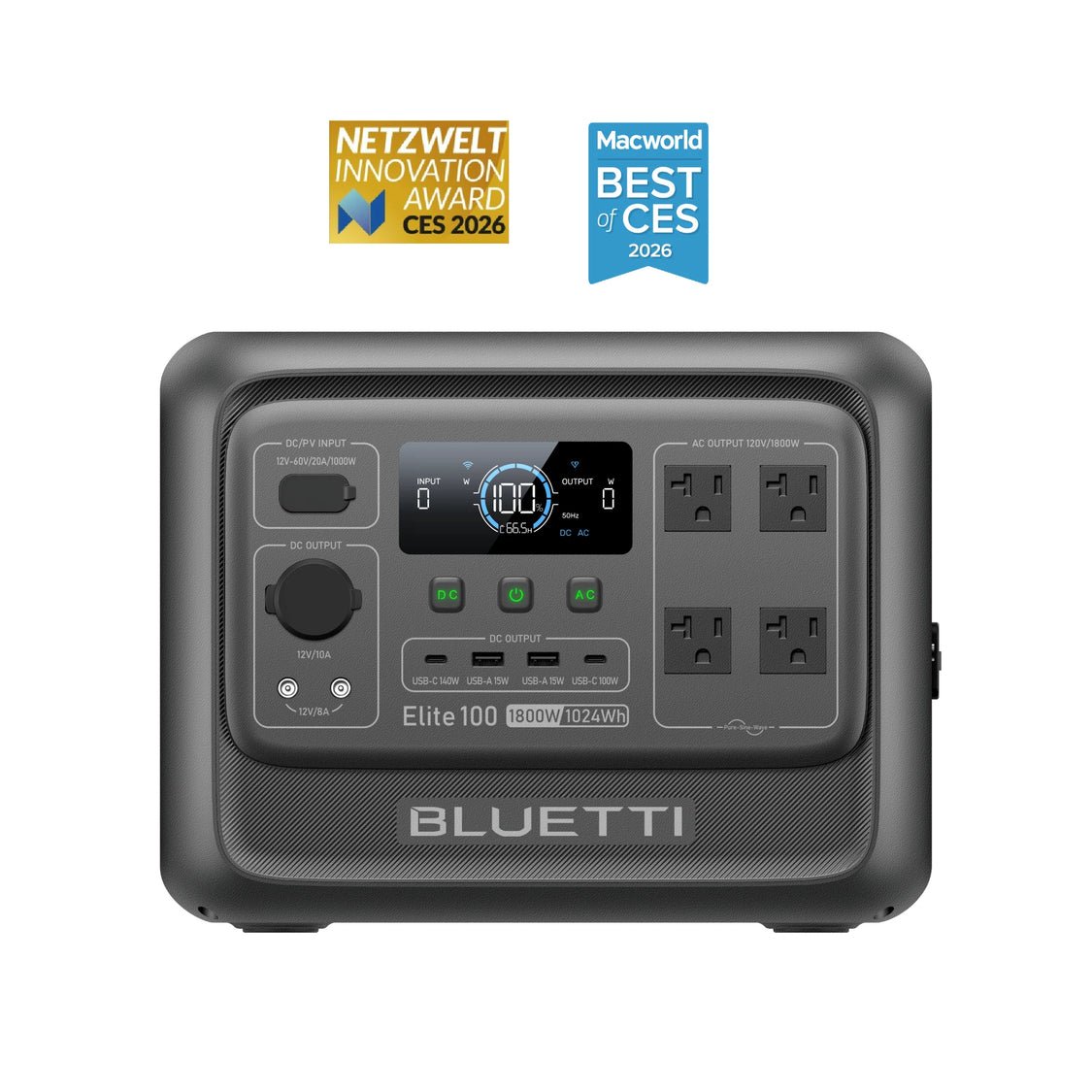
BLUETTI Elite 100 V2 — better balance of capacity and portability
BLUETTI specifies 1,024Wh capacity, 1,800W AC output and a weight of about 25.3 lb. It also provides high-power USB-C outputs and up to 1,000W DC input, which makes it well suited to vehicle-based camping where portability still matters.
Choose this class when: you mainly need electronics, lights, a laptop, selected refrigeration loads and occasional higher-power appliances, and you want something one person can move without much difficulty.
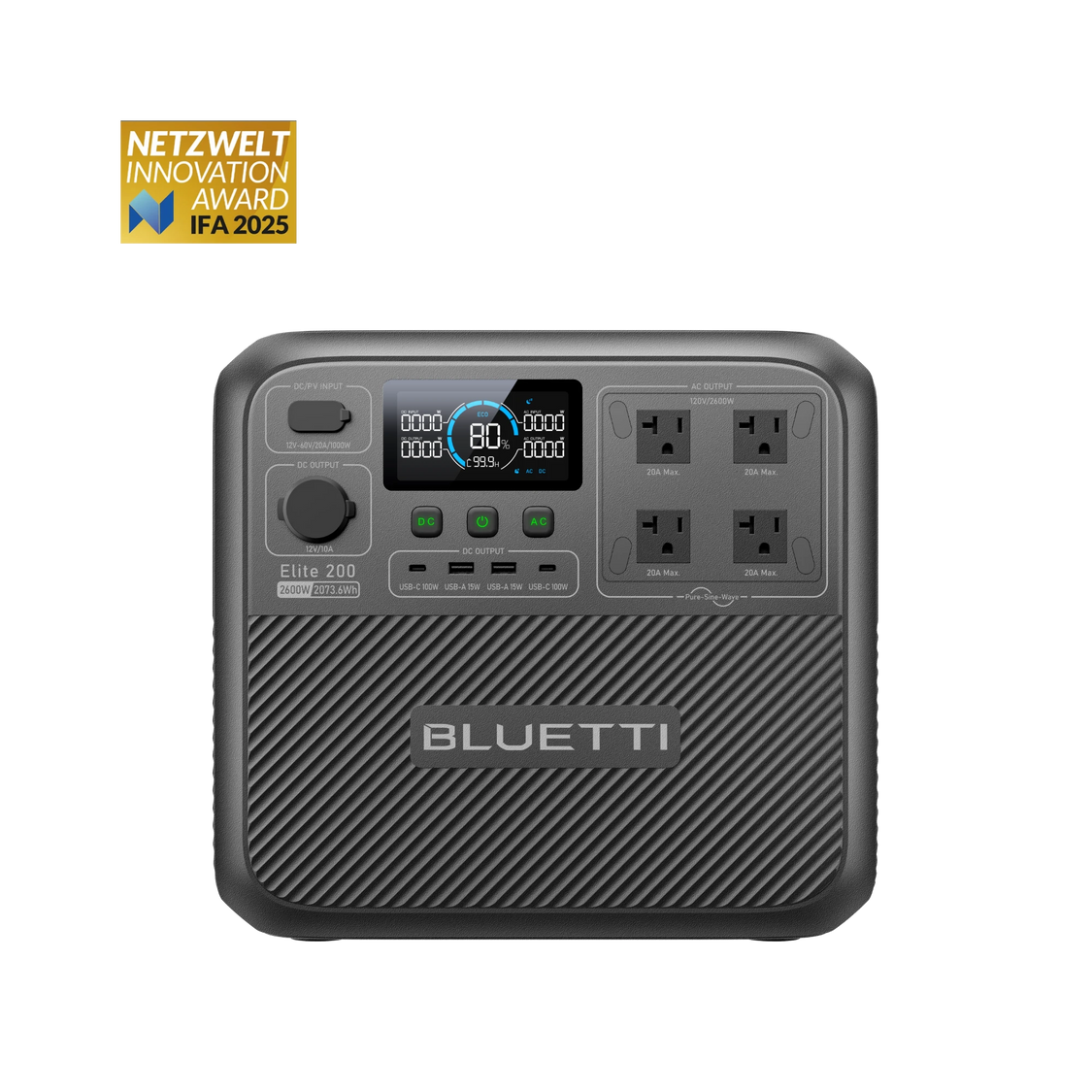
BLUETTI Elite 200 V2 — better for multi-day or higher-energy camping
BLUETTI specifies 2,073.6Wh capacity, 2,600W AC output and a weight of about 53.4 lb. The larger battery roughly doubles the stored energy of the 1kWh class, but it is much less convenient to move far from a vehicle.
Choose this class when: you are running a larger fridge, several devices, remote-work equipment, CPAP, cooking appliances or a multi-day campsite and want more reserve between recharges.
Do you need solar panels for camping?
If the trip lasts beyond one battery cycle, use our solar generator for camping sizing guide to match daily Wh with panel wattage.
Solar is useful when the trip lasts longer than the battery alone. But panel wattage is a maximum rating, not a daily-energy guarantee. Weather, shade, panel angle, temperature and charging limits all reduce real harvest.
As a simple upper-bound example, a 300W panel receiving four peak-sun-hours represents 1,200Wh of solar energy before real-world system losses. Do not assume that result every day. Size the battery so the trip is still workable when solar production is lower than expected.
What matters more than battery capacity
- Weight: a 2kWh station can be excellent at a vehicle campsite but impractical for carrying any distance.
- Ports: use DC/USB directly where practical rather than converting everything through AC.
- Charging speed: important if you have only a short window at a powered campsite or vehicle stop.
- Solar input limit: determines how much panel power the station can actually accept.
- AC output: check the continuous output against the appliances you plan to run together.
Frequently asked questions
How big of a power station do I need for camping?
Calculate your expected Wh/day first. Light electronics can fit below 500Wh, many car-camping setups fit around 1kWh, while multi-day trips with refrigeration or several users often justify 2kWh or more.
Is 1,000Wh enough for camping?
It can be, especially for one- or two-night vehicle camping with modest loads. It may be too small if a fridge, CPAP, laptop, cooking appliance or several people must run for multiple days without reliable recharging.
Can I run a camping fridge from a portable power station?
Usually yes if the voltage, port current and energy requirement match the station. Measure the fridge’s actual Wh/day because compressor cycling, ambient temperature and thermostat setting strongly affect consumption.
Is a solar generator the same thing as a portable power station?
In consumer marketing, “solar generator” usually means a portable battery power station used with solar panels. The battery stores energy; the solar panels recharge it.
Size the camping load before buying
Build your device list in the Backup Power Map, calculate daily Wh, then choose the smallest battery class that gives enough energy, output and reserve for the trip.
Specifications checked against BLUETTI US product documentation on September 19, 2026. Prices, stock and bundles can change. This guide does not claim hands-on product testing.
Featured photo credit: Luca Baggio / Unsplash.