
Still comparing sizes? Compare current BLUETTI power stations by capacity and use case →
Editorial note: This guide is based on published specifications and sizing principles, not hands-on testing. Verify your RV loads, connector requirements and manufacturer documentation before purchase.
Solar Generator for RV: How Much Power Do You Need?
Quick answer: size an RV solar generator from your measured daily energy use in watt-hours (Wh), the highest loads you may run at the same time, and how much solar energy you can realistically replace each day. A larger battery helps only if its inverter, ports and recharge system also match the RV.
Start with daily energy, not battery size
List the loads you expect to run away from shore power: refrigerator, lights, water pump, laptops, device charging, CPAP, fans and selected kitchen appliances. Multiply each load by expected hours of use, then total the Wh/day. Add reserve for conversion losses and changing conditions.
High-draw heating and air-conditioning loads can change the system size dramatically. Do not assume a portable power station will run every RV circuit just because its battery capacity looks large.
Three checks before buying
- Battery capacity: enough usable Wh for the time you want between recharges.
- Inverter output: enough continuous and surge power for simultaneous loads.
- Recharge: enough solar, wall or vehicle charging access to replace the energy you use.
What about TT-30?
Some RV owners prefer a power station with an RV-oriented TT-30 connection instead of adapting multiple individual outlets. Connector availability does not by itself guarantee that every RV appliance can be powered at once; inverter output and your actual load still set the limit.
BLUETTI Elite 300: a 3kWh-class RV option
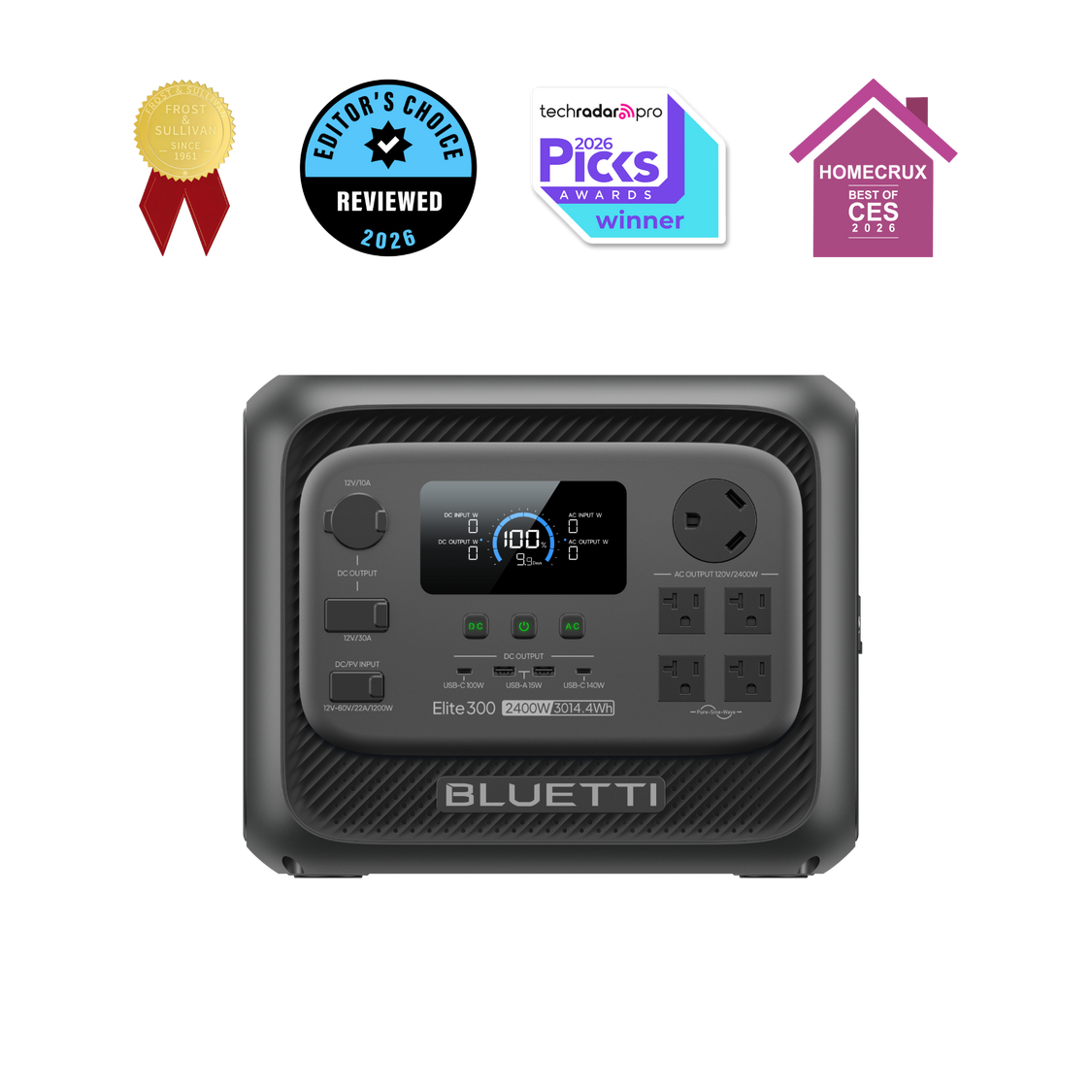
BLUETTI lists the Elite 300 with 3,014.4Wh capacity, 2,400W AC output, TT-30, up to 1,200W solar input and 10ms UPS switching. That combination makes it relevant when stored energy and RV-oriented connectivity matter, while the actual fit still depends on your load profile.
Read our BLUETTI Elite 300 specs and buying guide →
Check current BLUETTI Elite 300 offer →
When a smaller station can make more sense
If the trip is mainly lights, laptops, phones, a small fridge and other modest loads, carrying a 3kWh-class station may be unnecessary. Start with the load calculation, then compare a smaller class if it covers the required Wh and starting watts.
For lighter vehicle-based trips, see our portable power station for camping guide. For more solar-planning detail, see how much solar you need for camping.
RV solar-generator buying checklist
- Measure or estimate Wh/day.
- Identify the largest simultaneous AC load.
- Check compressor and motor starting surge where applicable.
- Confirm TT-30 or other connector needs.
- Estimate realistic solar production, not panel nameplate watts alone.
- Check weight and where the station will be stored and ventilated.
- Plan a non-solar recharge option for poor-weather days.
Bottom line
A good RV solar generator is not simply the largest battery you can buy. Match daily Wh, inverter output, ports and recharge rate to the way you actually camp. For users who need roughly 3kWh of nominal storage plus TT-30 connectivity, the BLUETTI Elite 300 is one option worth comparing.