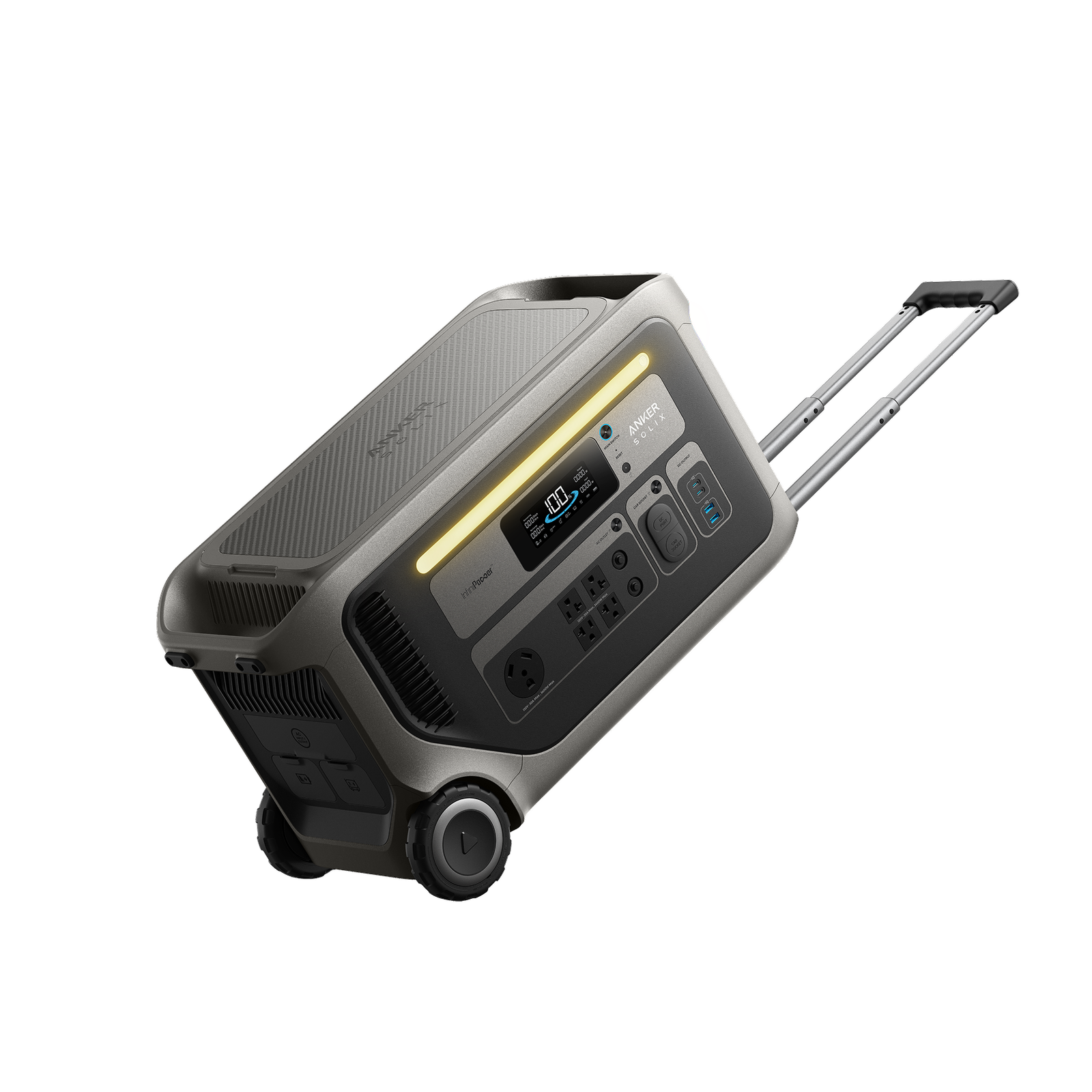
Quick take: Anker SOLIX F3000 is a large 3kWh-class portable power station aimed at home backup, RV use and higher-demand outage loads. Anker lists 3,072Wh battery capacity, 3,600W total AC output, 7,200W AC surge power and up to 2,400W solar input.
Editorial note: This is a specification-based buying guide, not a hands-on review. Specifications were checked against Anker’s official US product information in September 2026.
Anker SOLIX F3000 key specs
- Battery capacity: 3,072Wh
- Battery chemistry: LFP
- Rated cycle life: 4,000 cycles
- Total AC output: up to 3,600W
- AC surge power: up to 7,200W
- SurgePad power: up to 4,860W
- Solar input: up to 2,400W
- UPS transfer time: 20ms
- Expandable battery: supports BP3000 expansion batteries
- Weight: about 91.5 lb / 41.5 kg
Anker SOLIX F3000
Where the F3000 fits for outage backup
The F3000 sits above 1–2kWh portable power stations when the goal is to keep several essential loads running together or handle appliances with meaningful startup demand. Typical use cases can include refrigerators, lighting, networking equipment, televisions, selected kitchen appliances and other 120V household loads, provided the combined running load stays within the system and outlet limits.
For a backup plan around 2,500W continuous demand, the F3000’s 3,600W total AC rating gives substantially more operating headroom than compact 2,000–2,400W units. Its published 7,200W AC surge figure also makes it relevant when startup demand is high.
Important: surge rating does not automatically mean every 7,200W motor will start
A motor, pump or compressor must be checked against more than the headline surge number. Individual outlet ratings, voltage, connector type, startup duration and the appliance’s actual starting characteristics can all determine compatibility.
For example, a load estimated at 2,500W running and 6,700W startup is within the F3000’s published aggregate running/surge envelope, but that alone is not enough to guarantee a specific motor will start from a particular outlet. The Backup Power Map should treat the F3000 as a candidate that still requires connector and appliance-level validation.
120V and 240V expansion path
A single F3000 is designed around 120V backup. Anker also supports a dual-unit configuration with its Double Voltage Hub for 240V high-demand applications. That makes the platform more expandable than a small portable power station, but the required accessories and configuration should be included in the total system decision.
Runtime: 3,072Wh is capacity, not guaranteed usable AC energy
Actual outage runtime depends on inverter losses, state of charge, temperature and how loads cycle. A refrigerator and Wi-Fi router may average far less power over time than their nameplate or startup ratings, while heaters and other resistive loads can drain the battery quickly.
Use the Backup Power Map to estimate running watts, startup demand and required battery capacity before choosing a system.
When to consider a larger system
If your plan includes 240V loads, central air conditioning, larger well pumps or broader whole-home backup, compare the F3000 with higher-output expandable systems rather than choosing on battery capacity alone. Start with our Anker SOLIX F3800 home-backup guide for the 3.84kWh / 6,000W 120/240V step-up option.
Affiliate disclosure: WhenGridFails may earn a commission from qualifying purchases made through affiliate links, at no additional cost to you.