
Editorial note: This is a planning guide for US home backup systems. It does not replace a load calculation, manufacturer instructions, permits or qualified electrical installation.
Need to compare portable and expandable options? Compare current BLUETTI power stations by capacity and use case →
Quick answer: A whole-home battery backup must satisfy two separate requirements: enough power (kW) to run and start the loads that may overlap, and enough energy (kWh) to keep those loads running for the desired outage duration. 120/240V compatibility, transfer equipment and installation matter just as much as battery capacity.
Whole-home battery backup is different from a portable power station
A portable power station is usually connected directly to selected appliances. Whole-home backup can energize household circuits through compatible transfer or integration equipment. That changes the design problem from “how many watts can this box supply?” to “which circuits, voltages and loads must the system support safely?”
If you only need a refrigerator, internet, lights and a few plug-in devices, a portable or expandable system may cost less and be easier to deploy. Whole-home integration becomes more relevant when automatic switchover, 240V appliances or multiple circuits are priorities.
Size power and energy separately
Power: kW
Power determines what can run at the same time. Add the running demand of overlapping loads and separately verify motor or compressor startup behavior.
Energy: kWh
Energy determines runtime. Estimate appliance watt-hours over the outage period rather than assuming that a large inverter means long runtime.
Voltage and integration
Whole-home systems often need 120/240V support, listed transfer equipment, compatible panels or hubs and professional installation.
Start with essential circuits, not every circuit
Whole-home does not have to mean every load operates normally during an outage. A practical design often prioritizes refrigeration, internet, lighting, selected receptacles, a well or sump pump where applicable, and limited HVAC. Large resistive heating loads, electric dryers, ovens and central air conditioning can increase both inverter power and battery-energy requirements sharply.
Use the Backup Power Map to create an appliance-side plan first. Then separate the loads into must run, nice to have and leave off during an outage.
How much battery capacity do you need?
For each essential load:
Energy (Wh) = Watts × Hours of operation
Add the required watt-hours for the outage period, then account for system losses and operating reserve using defensible assumptions. Cycling loads such as refrigerators and pumps should be estimated from measured energy or realistic duty-cycle data rather than nameplate watts multiplied by 24 hours.
A 10kWh battery does not automatically provide 10kWh at household AC outlets. Usable delivered energy depends on system limits, conversion losses, temperature, reserve settings and load level.
120V and 240V matter
Many US homes contain 240V loads such as central air conditioning, electric water heating, well pumps, ranges and dryers. A 120V-only system cannot substitute for a 240V source simply because its watt rating is high enough.
Verify the exact output architecture and required integration hardware for the system you are considering. Do not backfeed a home through an improvised cord or receptacle.
Automatic transfer and installed equipment
A whole-home battery system may use a transfer switch, smart panel, home-integration hub or other listed equipment to isolate the home from the utility grid during an outage. The exact architecture varies by product and jurisdiction.
How much does a whole house battery backup cost?
Cost depends heavily on usable battery capacity, inverter power, 120/240V support and how much electrical integration the home needs. Current US search results show professionally installed whole-home systems commonly discussed in roughly the $15,000–$50,000+ range, while smaller essential-load or modular systems can start much lower. Treat these figures as planning ranges, not quotes.
Installation cost can include more than the battery itself: transfer equipment, panels, wiring, permits, service changes and labor may all matter. Compare complete installed systems rather than battery price alone. BLUETTI’s current US cost guidance similarly emphasizes capacity and installation as major cost drivers.
Current BLUETTI pathway to compare
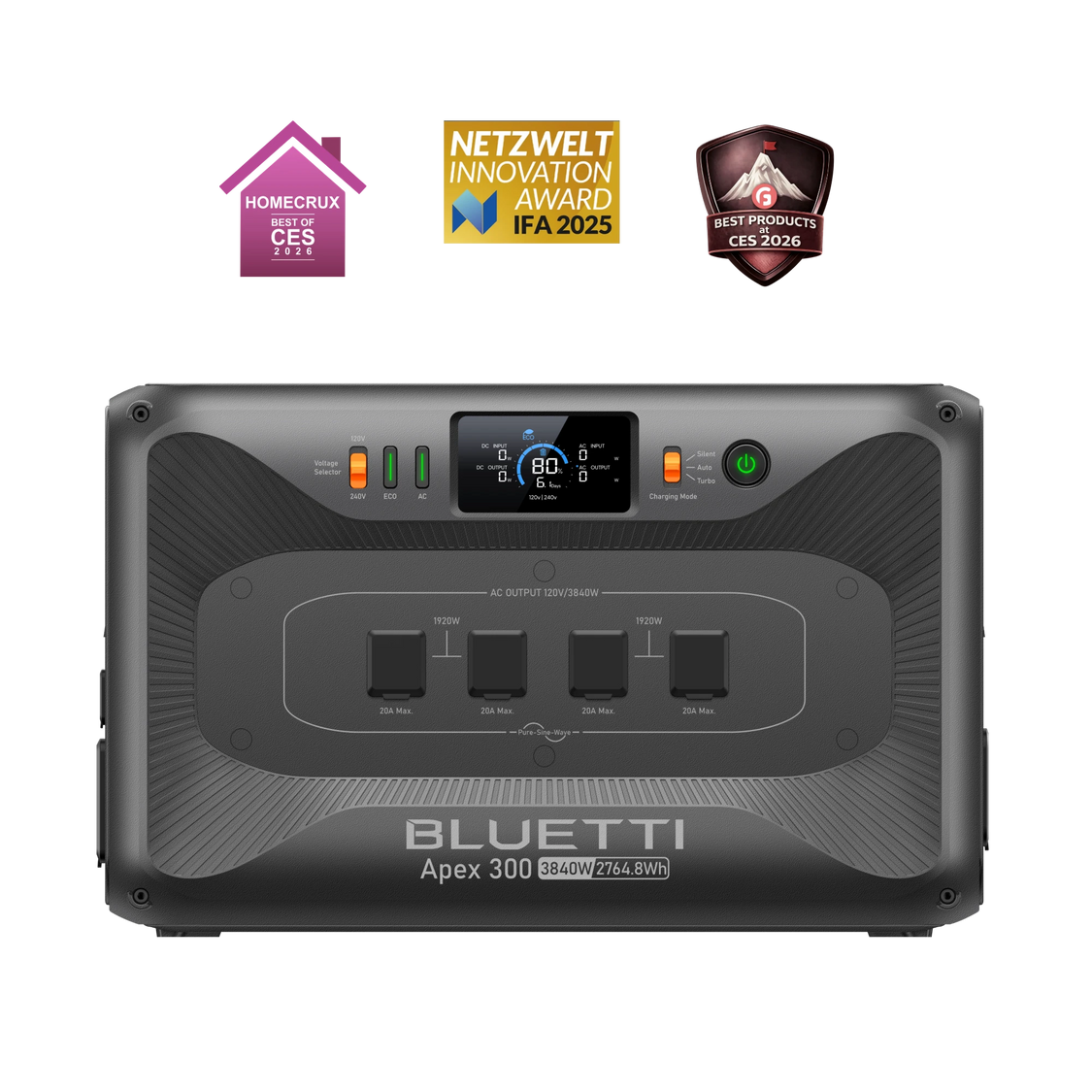
BLUETTI Apex 300 — expandable 120V/240V pathway
The Apex 300 base unit is listed at 2,764.8Wh and 3,840W, with a 120V/240V-capable architecture and expansion options. The base unit alone should not be treated as a complete whole-home installation; capacity, integration hardware and load requirements determine the final system.
When whole-home backup is probably overkill
- Your real outage goal is only a refrigerator, internet, lights and charging.
- Most outages last only a few hours.
- You do not need 240V loads during outages.
- You are willing to connect selected plug-in loads manually.
In those cases, compare our portable power station for home backup guide instead.
When whole-home backup makes more sense
- You want automatic circuit-level backup.
- You need selected 240V loads.
- You experience longer or frequent outages.
- You need more stored energy than a small portable system can provide.
- You want an expandable platform that can grow with future loads.
Bottom line
Whole-home battery backup is primarily an engineering and integration problem, not a battery-capacity contest. Define the circuits, simultaneous kW, required kWh, 120/240V needs and outage duration first. Then choose the smallest system architecture that meets those requirements safely.
For the broader comparison of portable, expandable and installed systems, see our home battery backup systems guide.